Define the Product Family Before Selecting Equipment
A detergent filling line should be specified around the liquids it will actually run, not around a generic description such as household chemicals. Hand soap, dishwashing liquid, shampoo and concentrated cleaner can differ widely in viscosity, density, foaming tendency and chemical compatibility. These differences influence the filling principle, nozzle design, pump speed, product path and cleaning method.
Create a product matrix that identifies viscosity at the expected filling temperature, density, pH, surfactant level, suspended particles and ingredients that may attack seals or hoses. Include normal production temperature because a warm product may behave differently after cooling. Safety data sheets and representative samples help the supplier evaluate wetted materials.
Mark products that cannot share a product circuit because of fragrance carryover, color change, allergen policy or quality requirements. This determines whether the project needs validated cleaning steps, dedicated hoses or tanks, or separate filling paths. A clear product matrix also prevents the easiest liquid from becoming the only basis for the quotation.
Match the Filling Principle to Viscosity and Accuracy
Several filling technologies can suit detergents, but their performance depends on the application. Piston or positive-displacement systems are often considered for viscous products and repeatable volumetric dosing. Flow-meter filling can provide flexible electronic recipes when conductivity, flow characteristics and meter compatibility are suitable. Net-weight filling can be useful when mass accuracy and product value justify weighing each container, while time-pressure or gravity methods may fit selected free-flowing products.
Ask each supplier to explain why the proposed method matches every critical product in the matrix. The answer should address the lowest and highest fill volumes, target tolerance, temperature variation and the time needed to complete the slowest fill. A headline nozzle count alone does not prove output if a thick product needs a long dosing and cutoff cycle.
Define how fill accuracy will be measured. State whether acceptance is by volume or mass, the sampling plan, the permitted range and whether container tare variation is included. For weight checks, density and temperature must be handled consistently when converting between mass and declared volume.
Control Foam, Drips and Product Strings
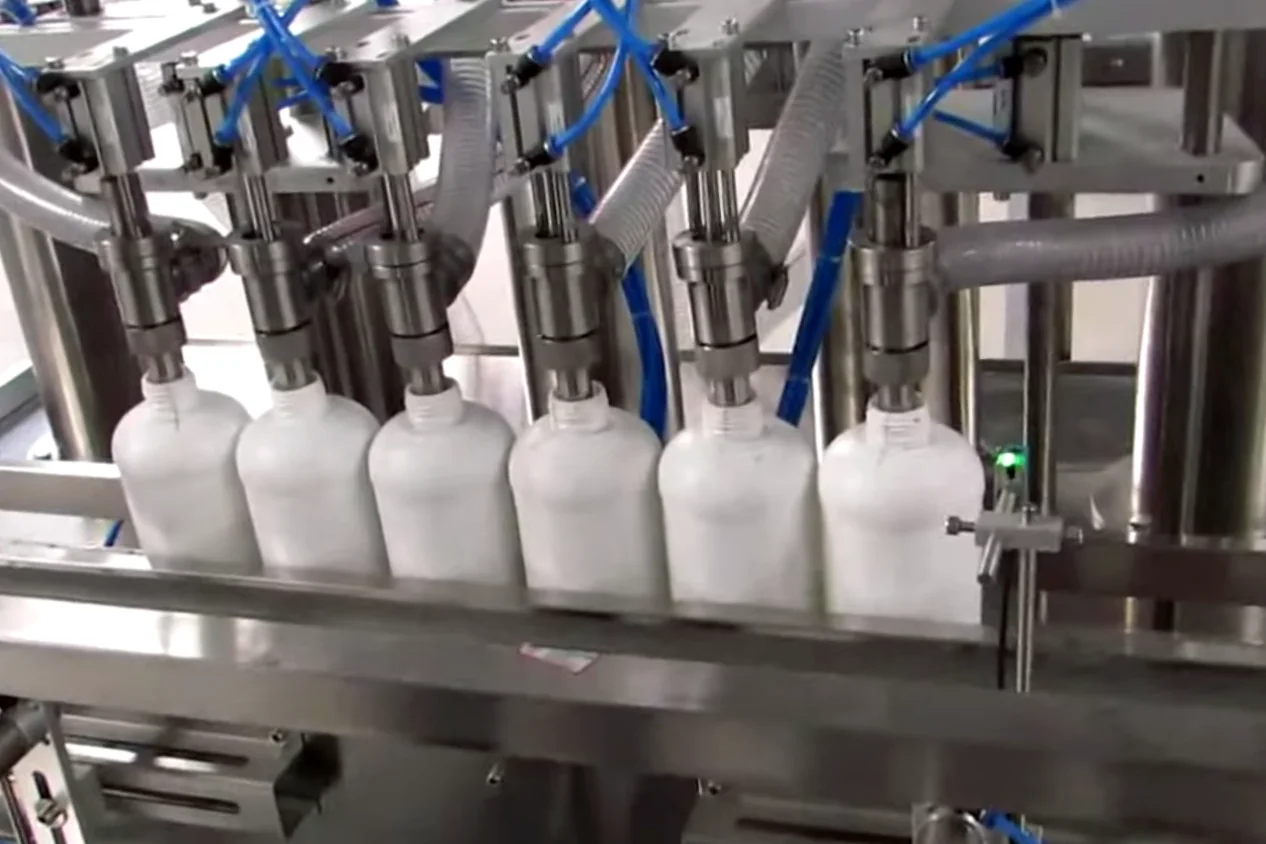
Foam is one of the most important variables in a detergent filling line. Excess foam can slow the cycle, obscure the true liquid level and contaminate the bottle neck. A suitable system may use diving nozzles that begin near the bottom of the container and rise with the liquid level, together with controlled acceleration and deceleration of product flow.
Nozzle cutoff matters as much as the main fill. Suck-back, positive shutoff or an application-specific nozzle can reduce drips and strings after dosing. The correct choice depends on viscosity and whether the product tends to stretch, cling or trap air. Drip trays may protect the conveyor during stops, but they should not be treated as a substitute for a stable cutoff.
Test foam behavior with production-representative product, bottle geometry and temperature. A laboratory sample that has rested for days may contain less entrained air than freshly mixed product. Upstream transfer pumps and return lines should also avoid unnecessary agitation before the filler.
Design Around Bottles, Caps and Product Presentation
Provide drawings and physical samples for every bottle, cap, pump or trigger closure in scope. Record container material, neck finish, filled weight, dimensional tolerances and the location of any handle or asymmetric feature. Tall narrow bottles may need close conveyor guidance, while flexible containers may deform under side pressure or when a nozzle seals against the opening.
The capping section must match the closure family. Simple screw caps, dispensing pumps and trigger sprayers require different sorting, placement and torque-control arrangements. Long dip tubes may need guided insertion and more space between stations. Define acceptable cap presence, alignment, torque range and container damage criteria for testing.
Detergent residue on the sidewall can reduce label adhesion, so the line should prevent splashing and identify contaminated bottles before labeling. Coding, induction sealing or tamper-evident features should be treated as integrated processes.
Confirm Wetted Materials and Chemical Compatibility
Stainless-steel grade alone does not establish chemical compatibility. Product-contact seals, gaskets, hoses, pump components and nozzle parts must also tolerate the formulation, cleaning chemicals and operating temperature. The buyer should provide safety and formulation information, while the supplier should identify proposed materials for review.
Compatibility decisions should be documented for the specific product set. If strong oxidizers, solvents or unusually aggressive cleaners are included, specialist material review may be required. Flammable products introduce a different risk assessment involving zoning, ventilation, electrical design and local rules; a standard detergent line should not automatically be assumed suitable.
Design the product path to minimize traps and uncontrolled dead legs. Accessible connections, drain points and clear identification of product-contact parts make inspection and cleaning more practical. Ask how residual product is recovered or disposed of at the end of a batch.
Plan Cleaning and Changeover as Production Tasks
Frequent fragrance, color or formulation changes can consume more production time than mechanical bottle changeovers. Define the required cleaning sequence, rinse media, disposal method and release criteria before finalizing the equipment. The machine layout should provide safe access to tanks, filters, manifolds, nozzles and product connections.
Recipes can store fill volumes, speeds and nozzle motion, but operators still need clear procedures for hoses, guides, cap tooling and label components. Ask the supplier to demonstrate the longest expected change during acceptance testing and record the labor, tools and time required.
Where cross-contamination risk is high, removable product circuits or dedicated change parts may be justified. The correct approach depends on product value, campaign length and quality policy. It should be agreed with the buyer's production and quality teams, not selected only on initial machine price.
Integrate the Complete Packaging Line
A detergent filler rarely operates alone. A complete line may include bottle feeding, filling, cap or pump insertion, capping, leak or level inspection, labeling, coding, case packing and pallet handling. Conveyors and accumulation must keep these machines supplied without creating excessive back pressure on flexible containers.
Define blocked, starved, ready, running and fault signals between machines. Controlled slowdown is usually more stable than repeated high-speed starts and stops. The line layout should also provide access for sampling, cleaning, rejected-container removal and safe intervention around each machine.
Review the full journey of unstable or handled bottles. Transfers, curves and gaps that look minor on a drawing can cause tipping. If triggers or pumps are fitted, their orientation may need to be maintained through labeling and packing.
Calculate Output from the Governing Product
Specify required good bottles per minute for each important product and container combination. The slowest condition may be the most viscous liquid, the largest fill, a highly foaming recipe or a closure that needs manual loading. The supplier should identify the limiting station and the assumptions behind every quoted rate.
Separate instantaneous cycle speed from sustained saleable output. Allow for replenishment, normal stops, sampling, cleaning and changeover. If future capacity is expected, determine which components can be expanded.
Utilities must support the agreed rate. Confirm electrical supply, compressed-air pressure and consumption, product feed pressure, tank arrangement and any ventilation or temperature-control requirement. Inconsistent supply conditions can make a capable filler perform poorly.
Use Real Materials During Factory Acceptance
Factory acceptance should use representative detergent, bottles, closures, labels and other critical packaging materials. The test plan should cover difficult products and formats, target speed, normal stops, restart, empty-container detection, no-bottle-no-fill logic and an agreed changeover. Water alone cannot demonstrate foam control, cutoff or viscous-product performance.
Measure fill results over a defined sample size and record the method, temperature and product batch. Inspect for foam overflow, neck contamination, drips, damaged bottles, missing or misapplied caps, torque variation and label problems. Count acceptable bottles at the agreed discharge point so rejected or reworked units do not inflate the result.
Document recipes and approved settings before shipment. Site acceptance can then confirm installation, utilities, integration and performance under plant conditions without redefining the original requirement.
Avoid Common Detergent Line Specification Mistakes
One common mistake is quoting a line from bottle size and nominal speed while ignoring product behavior. Another is testing only the easiest formulation or using water as a substitute. Buyers may also underestimate pump and trigger handling, cleaning time, chemical compatibility or the effect of fresh product containing entrained air.
Avoid accepting vague claims such as no dripping or quick changeover without a measurable test. Do not purchase excessive speed at one machine while leaving capping, labeling or accumulation unable to support it. A balanced line built around critical products normally delivers more useful capacity than isolated equipment with mismatched ratings.
Detergent Filling Line Buyer Checklist
Use this checklist when preparing a request for quotation and comparing detergent filling line proposals.
- Product matrix with viscosity, density, temperature, pH, foam behavior and safety data.
- Bottle, cap, pump and trigger drawings plus representative physical samples.
- Fill-volume range, accuracy method, tolerance and sampling plan.
- Required good-output rate for each critical product and container format.
- Proposed filling principle, nozzle motion, cutoff and drip-control method.
- Wetted-part, seal, hose and gasket materials for compatibility review.
- Cleaning, product recovery, changeover and cross-contamination requirements.
- Capping, inspection, labeling, coding, conveying and accumulation scope.
- Electrical, air, product-feed, ventilation and site-layout information.
- Factory acceptance plan using real product and packaging materials.
Build the Line Around Verified Product Behavior
A reliable detergent filling line connects product behavior with accurate dosing, foam control, clean cutoff, compatible materials and practical changeovers. Its performance should be proven as a complete process, from bottle infeed through closure and downstream handling, using measurable acceptance criteria.
For a project review, share the product range, containers and closures, target output and destination market. DST can evaluate filling, capping, labeling and conveying requirements together and recommend a configuration for testing with your actual materials.
Frequently Asked Questions
Which filling machine is best for liquid detergent?
The best method depends on viscosity, foam behavior, fill range, accuracy target and chemical compatibility. Piston, positive-displacement, flow-meter, net-weight and other systems can be appropriate after representative product testing.
How can a filling machine reduce detergent foam?
Common controls include bottom-up filling with diving nozzles, staged flow speed, stable product supply and reduced agitation. The settings should be tested with freshly prepared production-representative detergent.
Can one line fill detergent, shampoo and hand soap?
It may be possible when the fill range, viscosity, product-contact materials and cleaning process suit every formulation. Fragrance carryover, color change and cross-contamination requirements must also be assessed.
What should be tested during detergent line FAT?
Test critical products and formats at the agreed output, measure fill accuracy, inspect foam and dripping, verify closure application, run stop-and-restart scenarios and demonstrate the planned changeover and cleaning access.
Discuss Your Filling Project
Share your product, container, target output and destination market. DST will review the application and recommend a practical filling and packaging configuration.
Request a machine recommendation